

FIM in FloodFabric:
Background:
As a confluence of domains, Flood Inundation Mapping (FIM) borrows workflows and terminologies across several different disciplines, and a shared vocabulary is critical to being able to efficiently communicate the choices and distinctions between the various ways we map a flood. Here we'll outline the critical ones we've exposed in the .
Flood Inundation Mapping (FIM) sits at the confluence of several domains, borrowing workflows and terminology from multiple disciplines. A shared vocabulary is critical to effectively communicate the distinctions and choices involved in various mapping methods. This section outlines the core concepts integrated into the FloodFabric application.
Library terminology:
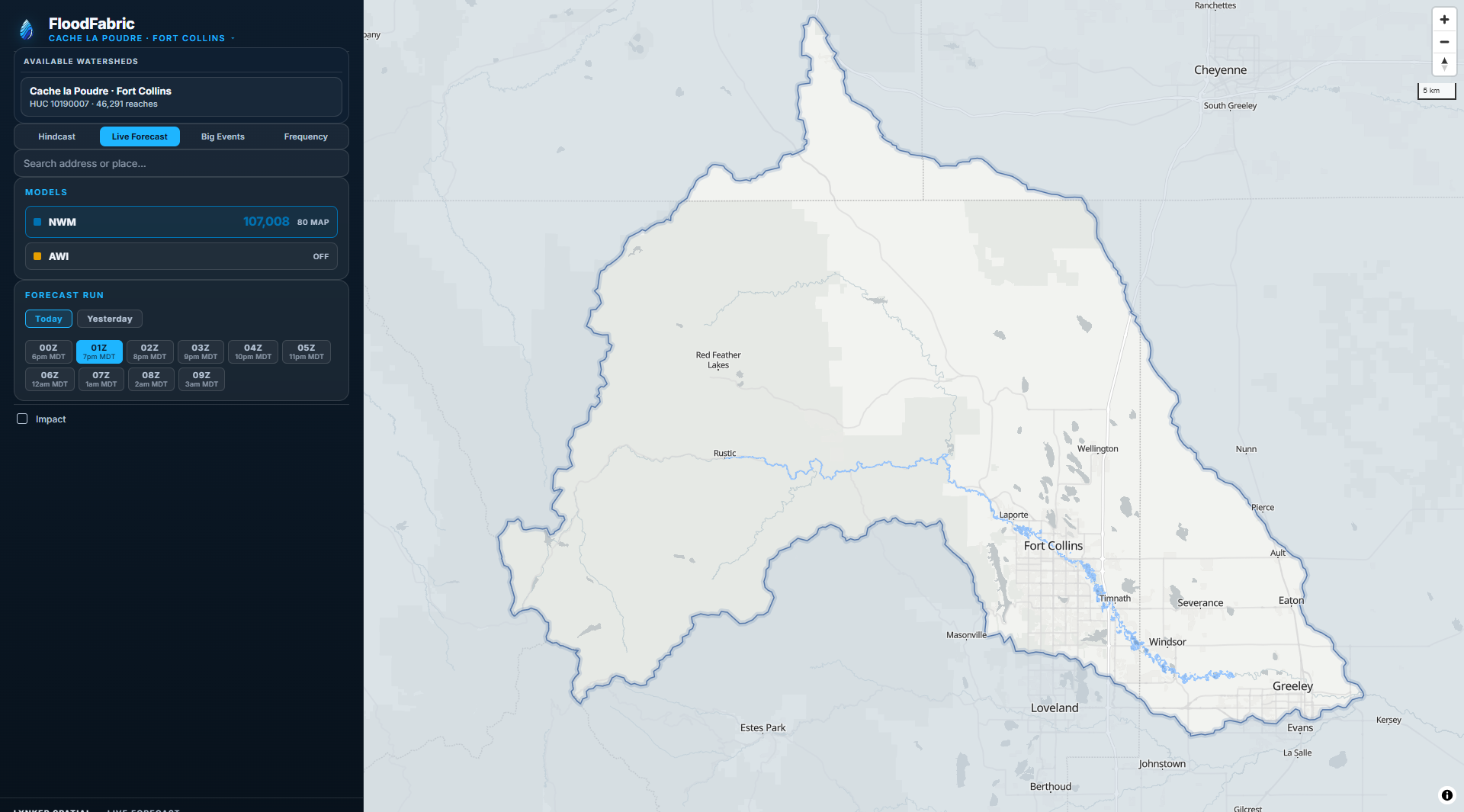
A FIM library denotes a specific database. These databases are composed of and partitioned into individual units referred to as volumes. FloodFabric harmonizes these varied volumes into distinguishable flood library access patterns, which are selectable via the menu on the left side of the dashboard. Currently,you can select the National Water Model HAND libraries and forecasts from the National Water Model or the AWI water model. You can also look at historic events, or flood predictions based on the NWM Hindcast. Check out the Hydro-intel scorecards or see the quickstart for more details.
Library access patterns:
You can access a FIM library in a number of ways. FloodFabric exposes discharge-based access patterns leaning on the FlowFabric API and model outputs. Want to see FloodFabric implemented specifically for your area? Please reach out!